
In brief
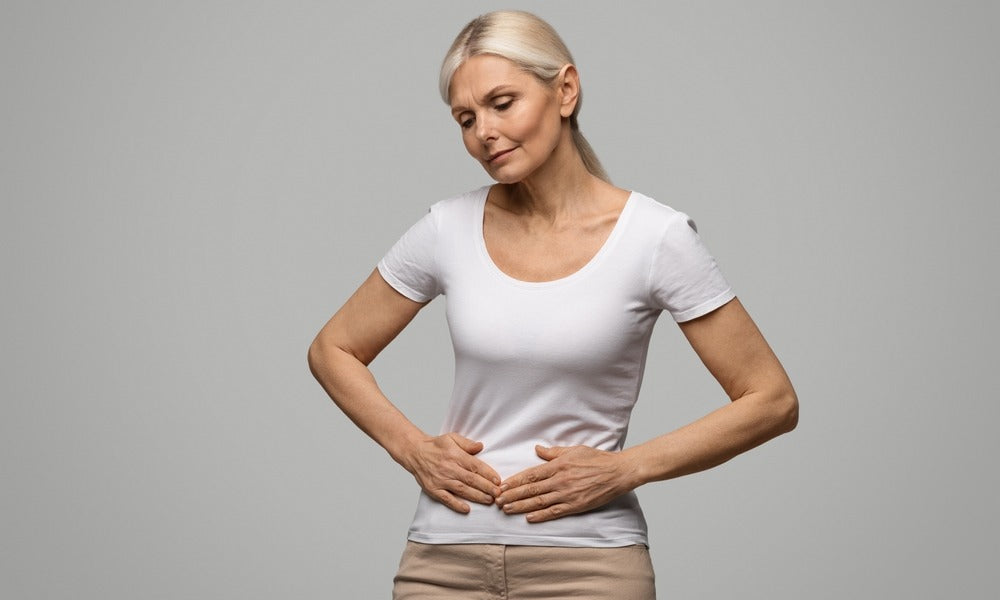
- Having lower abdominal pain after menopause is common, and it is not "normal" in the sense of "something to endure without doing anything."
- Six sensations occur most frequently: tugging, heaviness, uterine spasms, ovarian pain, pelvic pressure, and bloating.
- The underlying cause is the drop in estrogen, which weakens mucous membranes, relaxes supporting tissues, and slows down transit.
- Certain signs require a quick consultation, in particular any bleeding after menopause.
The 6 types of pelvic pain during menopause
Not all lower abdominal pain is the same. Putting a precise name on what you are feeling is the first step, because each sensation points to a different cause.

1. Lower abdominal tugging
A dull pull, often on one side, that appears when changing position or after exertion. Lower abdominal tugging most often reflects tension in the uterosacral ligaments and supporting tissues, which lose elasticity when estrogen drops.
2. Lower abdominal heaviness
A sensation of weight, as if something is "pulling downward," which is accentuated at the end of the day and relieved when lying down. This lower abdominal heaviness during menopause is often linked to a weakening of the pelvic floor.
3. Uterine spasm
A brief and intense cramp, very similar to period pain, which is all the more surprising given there is no longer a cycle. Uterine spasm after menopause corresponds to a contraction of the myometrium, the uterine muscle, which remains contractile even without hormonal support.
4. Ovarian pain
Localized, side-specific pain in the right or left iliac fossa. Ovarian pain during menopause is very real: the ovaries do not disappear, they simply stop ovulating. A residual cyst, an adhesion, or nearby inflammation can sustain this pain.
5. Pelvic pressure sensation
Different from simple heaviness: a permanent discomfort, sometimes accompanied by a frequent urge to urinate or a sensation of a vaginal "lump." This is the typical picture of incipient prolapse (organ descent), which is very common after age 60 and largely underreported.
6. Bloated stomach with pain
A bloated lower abdomen accompanied by ovarian or diffuse pain, which varies throughout the day and after meals. In the vast majority of cases, the origin is digestive: slower transit linked to the hormonal drop promotes bloating and distension.
Our article on a bloated stomach during menopause details this mechanism.
Why menopause causes lower abdominal pain
Pelvic pain in menopausal women is not imaginary. It stems from four well-documented physiological transformations, all triggered by the drop in estrogen.
Atrophy of the mucous membranes
Estrogen maintains the thickness, blood supply, and hydration of the vaginal, urethral, and bladder mucosa. Without it, these tissues thin out and become fragile. This is the Genitourinary Syndrome of Menopause (GSM), which combines dryness, burning, urinary discomfort, and lower pelvic pain. We detail it in our article on vulvar burning during menopause.
Relaxation of supporting tissues
Ligaments, fascia, and pelvic floor muscles lose collagen and tone. Pelvic organs are less well-supported, which generates that sensation of pressure in the lower abdomen that worsens during prolonged standing.
Slower transit
Lower estrogen and progesterone levels change intestinal motility. Constipation, bloating, and colonic distension become more frequent and manifest as diffuse lower abdominal pain, easily mistaken for gynecological pain.
Sensitization to pain
This is the most underestimated factor. Lack of sleep linked to night sweats, stress, and chronic fatigue lower the threshold for pain perception. At equal intensity, the same pelvic discomfort is felt more strongly after several broken nights. This is also why improving sleep often reduces pain, without having changed anything at the pelvic level.
When to consult a doctor

Most lower abdominal pain during menopause is benign. However, some situations require a quick medical opinion, and it is better to consult for nothing than to overlook something.
Consult without delay in the event of: vaginal bleeding after menopause, even if minimal and even if only once; sudden and intense pain; associated fever; unexplained weight loss; palpable mass in the abdomen; stomach bloating that has persisted for more than three weeks; blood in the urine or stool; pain that wakes you up at night.
The most important point: any bleeding occurring after menopause must be investigated, without exception. In most cases, the cause is benign (endometrial atrophy), but it is also the first sign of endometrial cancer, for which the prognosis is excellent when caught early.
Also consult, without emergency but without delay, if the pain has lasted for more than three months, if it interferes with your sleep, work, or intimate life, or if it is accompanied by urinary incontinence or a feeling of a vaginal lump.
5 solutions to relieve pelvic pain
Here is what actually works, classified according to the type of pain you are feeling. None of these approaches replace a diagnosis: they provide relief, they do not explain the cause.
1. Local heat, for spasms and cramps

This is the best response for uterine spasms and cramps. Heat applied to the lower abdomen (hot water bottle, cherry pit pillow, warm shower) relaxes the smooth muscles and improves local perfusion. The effect is rapid and application can be repeated. Plan for 15 to 20 minutes, without direct contact with the skin.
2. Perineal rehabilitation, for heaviness and pressure
This is the most effective solution for the sensation of pressure and pelvic heaviness, and by far the most underutilized after 50. Rehabilitation supervised by a physical therapist or midwife, over 10 to 20 sessions, strengthens the pelvic floor and reduces symptoms of organ descent. In France, it is prescribed by your doctor and covered. Results are seen in 6 to 12 weeks.
3. Hydration and diet, for a bloated stomach
If your pain is accompanied by bloating, the origin is likely digestive. Aim for 1.5 to 2 liters of water per day, gradually increase fiber (an increase that is too rapid worsens bloating), limit polyol sweeteners, carbonated drinks, and very heavy meals in the evening. A 20-minute walk after a meal does more for transit than most supplements.
4. Targeted cold, for burning and associated hot flashes
Cold is not the right answer for a uterine cramp, but it is for burning and heating sensations, as well as the hot flashes that often accompany this pain. Cold causes vasoconstriction and slows the conduction of nociceptive fibers: the burning sensation recedes in a few seconds.
This is the principle of targeted cryotherapy, and the function of Héra: a portable device that applies controlled cold to a thermosensitive area. Athana's internal measurements show a 15°C drop in skin temperature after 5 seconds, with an effect that persists for about ten minutes.
Let's be precise: Héra is a wellness device designed to relieve hot flashes and night sweats. It is not a medical device and does not treat pelvic pain or its causes. It acts on the thermal discomfort that frequently accompanies menopause, and it in no way replaces medical advice regarding lower abdominal pain.
5. Sleep and stress management, to lower the pain threshold
This is the slowest and most rewarding approach. Reducing nighttime awakenings, returning to regular schedules, and practicing moderate physical activity decrease central sensitization to pain. Many women find that their pelvic pain significantly subsides once their nights are stabilized, without any pelvic treatment having been implemented.
Hot flashes in addition to pain?
Héra applies targeted cold to the wrists, neck, or décolletage in seconds, without hormones or medication, day or night.
Discover Héra →⚠️ Medical disclaimer
This article is provided for informational purposes only. It does not replace medical advice. Any persistent, intense, or unusual pelvic pain must be evaluated by a doctor or gynecologist, and any bleeding after menopause requires a consultation. Lower abdominal pain can be linked to gynecological, digestive, urinary, or musculoskeletal causes that require a diagnosis.
FAQ - Your most frequently asked questions

Is it normal to have lower abdominal pain after menopause?
It is common, but that does not mean you have to endure it. After menopause, the thinning of mucous membranes, the relaxation of the pelvic floor, and slower transit explain most lower abdominal pain. Pain that lasts more than three months, intensifies, or is accompanied by bleeding must be medically investigated.
Can you have ovarian pain during menopause?
Yes. The ovaries stop ovulating but do not disappear, and they remain innervated. Lateralized pain can come from a residual cyst, post-surgical adhesions, or nearby irritation (colon, ureter). New ovarian pain after menopause justifies a pelvic ultrasound.
What is a uterine spasm during menopause?
It is a brief contraction of the myometrium, the muscle of the uterus, which remains contractile after menopause. It causes a cramp resembling period pain. It is usually benign. If the spasms are frequent or accompanied by discharge or bleeding, consult a doctor: a fibroid, polyp, or endometrial atrophy may be the cause.
Why is my lower abdomen bloated and painful during menopause?
In the majority of cases, the origin is digestive: the hormonal drop slows down transit and promotes bloating and distension. Changes in the distribution of abdominal fat accentuate the sensation. Persistent bloating beyond three weeks, especially if accompanied by a loss of appetite, must, however, be evaluated by a doctor.
Where does this sensation of heaviness in the lower abdomen come from?
It suggests a weakening of the pelvic floor, or even incipient prolapse. The sensation worsens at the end of the day, when standing, and during exertion, and improves when lying down. Perineal rehabilitation is the first-line treatment, and it is effective. Talk to your doctor, who can prescribe it for you.
I am 65 and have lower abdominal pain: is it linked to menopause?
Possibly, but after age 60 or 65, one must be more systematic. Non-gynecological causes (diverticula, urinary disorders, lumbar osteoarthritis, digestive pathology) become proportionally more frequent. New pain at this age deserves a clinical examination and, often, an ultrasound or further assessment.
Cold or heat to relieve lower abdominal pain?
It depends on the sensation. Heat is better suited for cramps and spasms because it relaxes the smooth muscles. Cold is better suited for burning, heating sensations, and hot flashes because it causes vasoconstriction and reduces pain conduction. You can test both: your feeling is the best indicator.

As seen on TV
Héra, the portable cryotherapy device
Targeted and immediate cold for hot flashes, without hormones or medication.
I discover HéraSources
- Ameli.fr - Menopause: symptoms and diagnosis: ameli.fr
- CNGOF - Clinical practice recommendations: menopause: cngof.fr
- National Cancer Institute - Endometrial cancer: symptoms and diagnosis: e-cancer.fr
- PMC / NIH - Genitourinary syndrome of menopause: a review: pmc.ncbi.nlm.nih.gov/articles/PMC6501752
- French National Authority for Health (HAS) - Genital prolapse in women: management: has-sante.fr
Leave a comment
All comments are moderated before being published.
This site is protected by hCaptcha and the hCaptcha Privacy Policy and Terms of Service apply.