

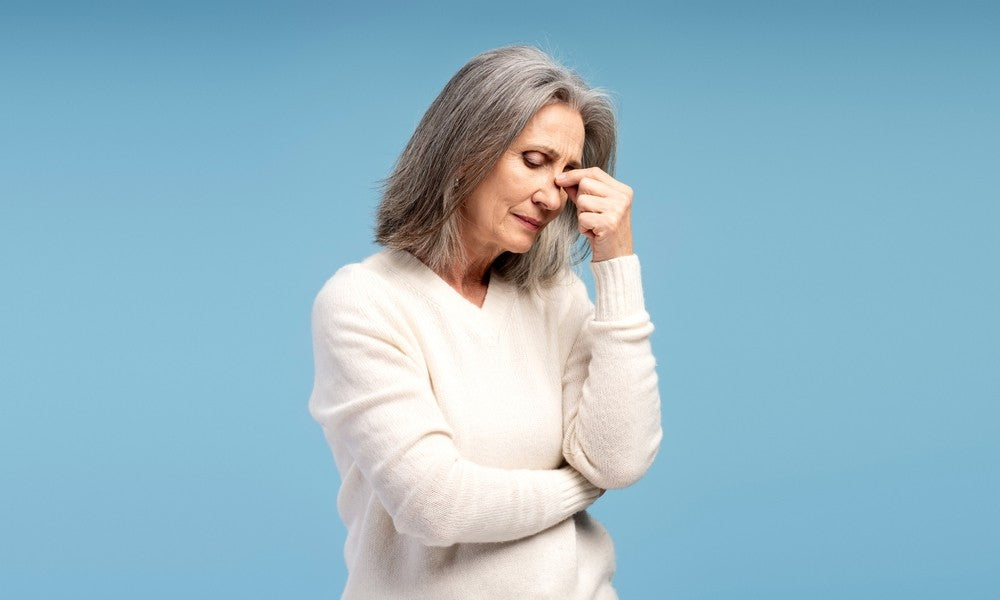
What if the biggest upheaval of menopause wasn't necessarily visible?
Not in the mirror, nor on the curves of the body when noticing that you have gained a little weight, but in that inner storm—quieter, heavier. This brain fog that arrives uninvited, that fuse of patience that snaps more easily, that strange feeling of being out of sync with yourself. We often talk about menopause through hot flashes, sleep disorders, lower abdominal pain, or cycles that become irregular before disappearing.
But what is said less often is that it can also affect your mood, your joy, your calm, and your self-confidence… because yes, this major change tires the body, but also the mind. Perhaps you no longer recognize your own reactions, you swing from calm to anger for no apparent reason, or you feel overwhelmed without really understanding why. What you are experiencing is neither exaggerated nor abnormal. It is not just a question of hormones, but a global change that affects the physical, psychological, emotional, and even identity levels.
- What is mental menopause?
- What are the symptoms of mental menopause?
- Why does menopause affect our mood?
- Does menopause affect morale?
- Does menopause affect personality?
- Does menopause cause depression?
- How to improve your mood during menopause: natural and effective solutions
- Rediscovering your smile during this important life stage
What we call mental menopause: this invisible, yet very real dimension. This weight on your shoulders that cannot be measured consists of mood disorders that arise when everything else in your life is going well… and that is precisely why it is essential to put words to these feelings.
In this article, we will explore what this brain fog really is, and above all, concrete ways to reclaim space in your mind and clear thinking. Because even if this stage is shaking things up, it is by no means a dead end!
What is mental menopause?
 Menopause is not experienced only in the body because, very often, it begins in the head. Do you feel on edge? Less patient than usual? Does everything irritate or upset you? What you are feeling is nothing abnormal: these are the effects of what is known as mental menopause. And according to the Ministry of Health, 87% of women aged 50 to 65 are affected by these symptoms…
This term, while not medical, refers to the mood and behavioral disorders that appear during this period. It is not just about fatigue or stress; it is a true emotional imbalance, caused by the sudden drop in hormones such as estrogen and progesterone.
As with insomnia, this can cause emotional instability, hypersensitivity, mood swings, irritability, or even a loss of motivation. This type of reaction is common but rarely recognized; menopause symptoms linked to mood remain largely silent in traditional medical discourse.
In reality, your brain, your mood, and your ability to manage daily life are all influenced by the physical changes you are going through. And when the hormonal chemistry collapses, the entire balance of your mental health can waver.
This phenomenon also involves affective disorders: we feel more vulnerable, less confident, we even develop social withdrawal, and above all, we experience a drop in libido with our partner. But this phase is not a weakness; it is merely a sign of profound hormonal changes!
What are the symptoms of mental menopause?
 As we have already explained, the effects of menopause do not stop at classic physical symptoms, because in the shadows, other more discreet, yet equally powerful symptoms can disrupt your daily life. Here are the main symptoms of mental menopause, as described by many women:
- Uncontrollable mood swings: one of the most frequent signs is this change in emotional state that can arise without warning. You are calm, then annoyed, then suddenly sad… all within a few minutes. These mood swings make daily life unpredictable and exhausting, for you and for those around you.
- Strong irritability: everything feels heavier, more annoying. Small noises, an innocuous remark, an unexpected event… everything becomes a source of tension. This is not a character flaw: this irritability is often linked to hormonal imbalance and accumulated fatigue.
- Mental fatigue: we just mentioned it... even after a decent night's sleep, you feel drained, accompanied by extreme fatigue. Thoughts are slower, you have trouble concentrating and organizing your ideas; this brain fog is common and heightens the feeling of losing control.
- Emotional hypersensitivity: emotions are more vivid, more intense. A phrase that would never have affected you before might upset you today. This emotional instability can make you feel constantly on edge.
- Loss of motivation and pleasure: what used to stimulate you, such as outings, projects, and hobbies, now seems uninteresting, almost as if you never enjoyed doing them. This drop in motivation is not laziness; it is a true signal of menopause fatigue, sometimes associated with deeper emotional distress.
- Depression: for some women, hormonal upheavals do not just cause mood fluctuations, but trigger a deeper, more persistent sense of malaise. If sadness becomes a daily occurrence, if you lose your drive and enthusiasm, and everything feels heavy or useless, this may indicate depression…
- Stress and anxiety: even without a specific event, a latent sense of worry sets in. This chronic stress becomes a backdrop that tires both body and mind. It can be accompanied by physical tension or persistent sleep disorders.
- Memory and concentration issues: these memory issues where you forget a word, an appointment, or lose the thread of a sentence. These small lapses are frequent during this period and are explained by hormonal changes that influence cognitive functions.
- Lowered self-esteem: with physical changes, weight gain, wrinkles, or a drop in libido, your relationship with yourself can become fragile. This affects mental health and reinforces the impression that you are no longer the same in your own eyes.
- Emotional isolation: tired of having to explain yourself, you sometimes withdraw into yourself. And because these symptoms are invisible, you feel misunderstood, sometimes even cut off from the world. This social withdrawal is often a reflection of a deep need for rest… but one that can also become a real trap.
Why does menopause affect our mood?

What you are feeling is no coincidence.
If your mood escapes you, if your emotions take over without warning, it is not because you are “too sensitive.” It is because several mechanisms—biological, neurological, psychological, and social—are activated simultaneously during menopause.
This period acts like an inner earthquake. It disrupts your bearings, alters your internal balance, and sometimes makes you lose your footing without you being able to explain why. It is important to understand that these upheavals are normal and have specific origins.
In the following sections, we will explore together the various reasons why menopause can affect your mood, your emotional stability, and more broadly, your mental health.
Hormonal upheaval: an inner earthquake
The first factor, and arguably the most well-known, is the drop in sex hormones: primarily estrogen and progesterone. This radical change does not only affect fertility or the menstrual cycle; these hormones also play a major role in regulating emotions.
Estrogen, for example, acts directly on the production of serotonin, one of the neurotransmitters responsible for mood and well-being. When its levels collapse, emotional regulation becomes more difficult: you may feel more sadness, less enthusiasm, or have trouble staying calm. It’s a bit like having your internal emotional thermostat out of whack.
Progesterone, on the other hand, has a more soothing effect: it acts as a moderator by influencing the GABA receptors in the brain, a neurotransmitter that promotes relaxation and sleep. When it drops, we observe an increase in irritability, agitation, and sometimes sleep disturbances… all factors that promote the appearance of mood disorders.
This is where the role of hormones makes perfect sense: their imbalance undermines the foundations upon which your inner stability rested. The result? Emotions become more unpredictable, more intense… and often more exhausting to manage.
The brain is reorganizing
What is less commonly known is that the brain also goes through an adaptation period during menopause.
Certain key areas, such as the amygdala (the emotion center) or the hippocampus (memory, learning), are directly influenced by hormones because when they drop, these areas lose some of their reference points.
This can lead to a drop in concentration abilities, greater emotional reactivity, or that sensation of brain fog that many women describe. The brain is looking for a new balance, but this process takes time and can generate real emotional instability while waiting for the circuits to reorganize.
In short, what you are feeling is not a weakness, but the concrete result of a brain under construction. Much like software updating, it may experience temporary bugs… but it always ends up stabilizing!
A destabilizing identity milestone
Menopause is not just a hormonal upheaval: it is also a period when your identity wavers. What you are experiencing internally does not only concern your emotions, but also affects the perception you have of yourself, your place, and your role.
For years, you may have been defined (in part) by your femininity, your ability to give life, and your physical energy. And suddenly, without you choosing it, this chapter is closing. Even if you do not experience it as a loss in the strict sense, it is a profound transformation. For some, this can awaken questions that have remained unanswered: Who am I today? What do I want?
Added to this is the gaze of others, sometimes clumsy, sometimes silent.
In a society that values youth and performance, the transition to this new phase can lead to a feeling of invisibility, or even devaluation. This identity shock has a real impact on mental health and self-esteem during this menopause period.
In short, it is not simply a biological stage.
It is a moment of doubt and personal repositioning, often uncomfortable, but also potentially liberating, if we allow it the space to exist fully.
Chronic fatigue and physical ailments
It is difficult to maintain emotional balance when you are constantly exhausted. However, fatigue linked to menopause is not just a simple slump; it is a profound weariness that resists rest and is often accompanied by a host of physical ailments.
This fatigue can be caused by several factors: sleep disturbances (insomnia, waking up at night), night sweats, diffuse pain, muscle tension… your body is constantly mobilized to adapt to a new balance, which exhausts it. And when the body is drained, the mind follows. The slightest annoyance becomes more difficult to manage, and emotions rise to the surface more quickly.
The physical changes themselves: joint pain, vulvar burning, and hot flashes can also alter your self-perception and accentuate mood disorders. You feel less like “yourself,” and that directly impacts your morale.
Emotional isolation and lack of recognition
There is something particularly hard to live through during perimenopause: the impression of not being heard. Your emotions change, as does your behavior… but around you, few people seem to really grasp what you are going through. People advise you to put things into perspective, to take a step back, as if what you were feeling wasn't entirely legitimate.
This disconnect creates a gap: little by little, you talk less, you internalize. And without realizing it, emotional isolation sets in. Not necessarily very visible from the outside, but nonetheless very real. A quiet withdrawal, caused by the feeling of being misunderstood, or even invisible.
This feeling is all the stronger because society speaks little, or poorly, about menopause… it is made into an embarrassing subject, almost taboo. Affective disorders, although frequent during this period, remain in the shadows. The lack of institutional and social recognition does not help matters because it leaves women alone with their doubts, their guilt, and their fatigue, without a framework to support them.
However, this silence can weigh as much as the symptoms themselves.
Not feeling supported increases the mental load, fuels anxiety, and further weakens psychological health. It is not the distress itself that isolates… it is the fact that it is not recognized.
Does menopause affect morale?
 Yes, and significantly for many women.
This is not just a passing slump: it is a profound, sometimes lasting impact on emotional balance. When estrogen levels drop, the production of serotonin, also known as the happiness hormone, decreases: less drive, less lightness, and a tendency to see things in a darker or more discouraged way.
Add to that physical fatigue, bodily changes, sleep disturbances, and a certain isolation, and you have a cocktail that weighs heavily on morale. It is therefore no coincidence that you feel more irritable, sadder, or more quickly discouraged… these are the effects of the body, the brain, and the context of life mixed together.
Does menopause affect character?

It does not change your character, but it clearly affects how you react, feel, and interact.
You may surprise yourself by being more impulsive, more sensitive, or on the contrary, more distant. It is not that your personality has changed: it is that your threshold for emotional tolerance has been lowered by fatigue, stress, and hormonal imbalance.
We are talking here about temporary, but marked, emotional instability.
Character traits like patience, enthusiasm, or sociability may diminish, simply because the body has fewer resources to express them. This can create a real disconnect between who you were and who you feel like you are at the moment.
Does menopause cause depression?

It can, yes; depression and menopause can go hand in hand.
Even if not all women experience depression during menopause, a large number feel an emotional fragility that can evolve into a depressive state if it is not supported. According to a 2023 study by the Global prevalence of depression in menopausal women, 35.6% of menopausal women exhibit depressive symptoms…
One must not confuse passing blues with established depressive symptoms. If you feel persistent sadness, a loss of interest in what you used to enjoy, a feeling of emptiness, or sleep disorders, it may be menopausal depression.
It is a very specific form of depression, but it is recognized in the medical world because it deserves serious attention, and above all, support!
We have actually already written a comprehensive blog post on depression during menopause; feel free to take a look to get informed on the subject.
How to regain your morale during menopause: natural and effective solutions
 Feeling distressed during menopause does not mean you have to endure it in silence. Even if this period is marked by hormonal and emotional imbalances, there are now many approaches to help you regain a state that is more serene, stable, and, above all, more true to yourself.
It is not about looking for a miracle solution, but about combining small adjustments, informed choices, and simple daily actions that can have a real impact on your mental health and emotional balance. Sometimes, these are habits to resume or support that you need to dare to ask for.
In the following sections, we will explore three major natural and complementary levers: lifestyle (diet, movement, sleep), natural solutions and hormones, and finally psychological support, too often forgotten but essential...
Lifestyle and diet
We often underestimate the power of daily habits. Yet, one of the simplest and most effective keys to regaining morale during menopause is to take control of your lifestyle again. No drastic revolution, but gentle, regular adjustments that recharge the body… and the mind.
Physical exercise, for example, is a precious ally.
A daily walk, a gentle yoga session, or swimming can be enough to kickstart the production of endorphins, the natural hormones of well-being. These moments of activity, however modest they may be, also promote better sleep, a more stable metabolism, and a more balanced mood.
As for your plate, certain nutritious foods for menopause can have a direct effect on emotional balance: omega-3s (fatty fish, walnuts, flaxseeds), magnesium (almonds, dark chocolate, green vegetables), plant proteins, and foods rich in phytoestrogens such as soy.
Conversely, it can be useful to limit caffeine, refined sugars, and alcohol, which often accentuate irritability or mood disorders… just like smoking, for that matter!
These adjustments are not always enough on their own, but they constitute a solid foundation, often neglected, upon which other more targeted solutions can rely.
Natural solutions
 When morale wavers, emotions overflow, or fatigue becomes overwhelming, women are increasingly turning to natural treatments to relieve the effects of mental menopause. And rightly so: some gentle approaches can offer real relief without heavy side effects.
Among the best known are medicinal plants such as St. John's wort (recognized for its effects on mild depressive symptoms), sage (useful against hot flashes), or valerian and passionflower, which are ideal for soothing tension and facilitating sleep. Essential oils (such as true lavender or ylang-ylang) can also support emotional well-being on a daily basis when diffused in your living space.
But today there are even more innovative solutions: Héra, for example, is a new-generation device designed to relieve women going through menopause. It is not a medication, nor a hormone replacement, but a cryotherapy tool that delivers targeted cold waves where the body needs them.
What Héra brings is immediate relief, especially for hot flashes, but also a sensation of comfort and regaining control over your body. It has been designed not only for menopausal women, but also for those who suffer from hot flashes during their periods or during extreme summer heat.
It is a great illustration of what non-hormonal and, above all, non-invasive treatments for menopause can offer: relief, without further upsetting a body already in full transition.
Hormonal treatments
When talking about menopause, hormonal solutions are often among the first options proposed. This is called hormone replacement therapy (HRT), which consists of reintroducing hormones into the body—generally estrogens, sometimes combined with progesterone—to compensate for their natural drop.
These treatments can prove very effective in relieving a large number of menopause symptoms, including emotional disturbances: anxiety, irritability, mental fatigue, and even certain mild depressive symptoms. By restoring a certain hormonal balance, they sometimes allow for a faster return to emotional stability.
However, this type of therapy does not suit all women. It requires a complete medical check-up, regular examinations, and may be contraindicated in cases of family history of hormone-dependent cancer, cardiovascular disorders, or specific pathologies.
Furthermore, it is not a magic solution. If the emotional imbalance is also linked to psychological, identity-related, or social factors, hormonal treatments will not be able to fix everything. They can provide relief, but they do not replace listening to oneself or the inner work often necessary during this period of transformation.
In short, it is an interesting avenue to consider, but it must always be accompanied by careful medical follow-up… and above all, supplemented by other more natural and gentle levers.
Psychological support and social connection
Talking, being listened to, feeling understood: this may seem simple, but it is often what women experiencing mental menopause lack the most. Yet emotional support is one of the pillars of well-being during this period.
Consulting a psychologist or a therapist specializing in life transitions can make a real difference. Not to cure something, but to put words to what you are going through, give meaning to your emotions, and regain a form of inner coherence. Menopause and psychological aid are still too often dissociated, even though the effects of this psychological work can have more than effective results.
Beyond professional support, there is also the power of connection. The one we create or maintain with our loved ones, friends, and colleagues. Being surrounded by caring people who are capable of listening without minimizing helps to break out of emotional isolation. It also allows you to release the pressure, to feel lighter… quite simply.
And sometimes, all it takes is a gesture, a word, or an act of attention.
So, why not take advantage of Mother's Day to offer more than a traditional gift? Whether it is for your mother, your wife, your sister, or a woman you hold dear in your heart, offer them something that relieves and soothes during this period of premenopause, perimenopause, or postmenopause that has caused them so much suffering… offer them the Héra device.
And since we want to thank you for making it this far, take advantage of a 35% discount with the code MAMAN20 !
Finding your smile again during this important life stage
 The hardest part of what you are going through may not be what you are feeling… but the fact that you have to go through it in silence. This emotional fog, the fatigue that clings to you, those mood swings you can no longer control—none of it is exaggerated, and none of it is imagined. It is real, profound, and above all, it is shared by many more women than you might think.
Menopause and this brain fog are not a sign of weakness. It is a transition phase, sometimes uncomfortable, but one that can also open up a new space: one of recentering, reclamation, and self-care. Because behind the apparent disorder, there is a possibility for transformation, rebalancing, and newfound freedom.
You do not have to choose between suffering in silence or over-medicalizing. Between natural solutions, psychological approaches, body care, and new innovations, there are now gentle, adapted, and above all respectful ways to support who you are. The secret is to listen to yourself and dare to take care of yourself, without guilt.
It is not about becoming who you once were, but about becoming fully who you are now: empowered by your emotions, your life experience, and this new chapter that you have every right to write… in your own way!
FAQ
When does menopause end? Menopause is officially considered complete when no menstruation has been observed for 12 consecutive months. This stage marks the permanent end of fertility. However, it is important to note that some menopause symptoms, particularly those related to mood, sleep, or energy, can persist long after this period. Postmenopause can last for several years, during which mood swings may still be felt, even if their intensity tends to decrease gradually.
What are the 3 phases of menopause? Menopause spans three main phases:
- Perimenopause: This is the transition period, often the most unstable. Cycles become irregular, the first hot flashes and sleep disturbances appear, and emotions become more unpredictable.
- Menopause: This corresponds to the complete cessation of periods for 12 months. It is a definitive hormonal shift.
- Postmenopause: This phase begins after one year without periods. Physical and psychological changes stabilize, but some effects, particularly on mental health, may endure.
Why am I so irritable during menopause? Irritability during menopause is directly linked to hormonal imbalance, particularly the drop in estrogen and progesterone. These hormones influence the production of serotonin, a neurotransmitter that plays a central role in mood management. When their levels decrease, your emotional threshold also drops. Added to this are other factors such as chronic fatigue, menopause-related sleep disturbances, physical pain, or hot flashes, which reinforce the feeling of constantly being on edge.
What is the psychological impact of menopause? Menopause can have a profound impact on mental health. Beyond the physical symptoms, many women experience a significant emotional imbalance: mood swings, anxiety, loss of motivation, feelings of isolation, or depressive symptoms.

Leave a comment
All comments are moderated before being published.
This site is protected by hCaptcha and the hCaptcha Privacy Policy and Terms of Service apply.