
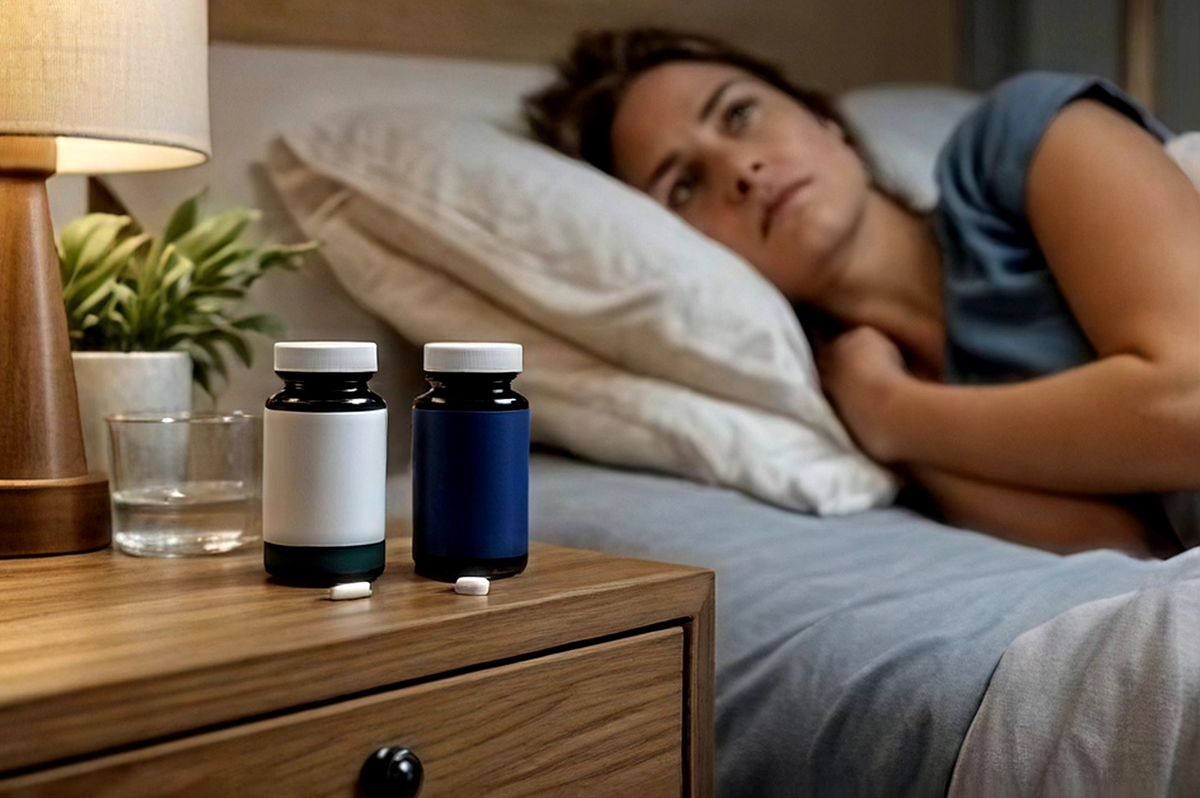
In brief
- Between 40 and 56% of women report sleep difficulties during peri- and post-menopause [Source: Frontiers in Sleep, 2024].
- Three mechanisms combine: a drop in progesterone (the brain’s natural sedative), a drop in estrogen (which disrupts thermoregulation), and shifted cortisol.
- 3 natural solutions make a real difference: an optimized sleep environment, magnesium and melatonin, and consistent routines.
- Their common blind spot: they do nothing when a night sweat wakes you up at 2 a.m. This is where targeted cooling changes the game.
Why menopause destroys your sleep
Sleep does not deteriorate by chance during menopause. There is a precise hormonal mechanic behind every wake-up, and it rests on three pillars.
1. The drop in progesterone
Progesterone has a naturally sedative effect on the brain. It promotes falling asleep and maintains deep sleep phases. When its levels collapse during perimenopause, you lose this integrated "natural sleeping pill." Result: you fall asleep less quickly, you wake up more easily, and your sleep becomes light and fragmented.
2. The drop in estrogen
Estrogen regulates thermoregulation via the hypothalamus, your brain’s "thermostat." When its levels drop, the hypothalamus becomes hypersensitive to temperature variations. It interprets a slight rise as overheating and triggers an emergency response: vasodilation, intense sweating, a feeling of overwhelming heat. This is a night sweat, and it pulls you out of deep sleep in seconds.
3. Dysregulated cortisol
Menopause also disrupts the circadian rhythm of cortisol, the stress hormone. Its morning peak can shift, waking you up too early and preventing you from falling back asleep. Hormonal insomnia during menopause is therefore three mechanisms adding up, not just one. This is also why a single solution is rarely enough.
It’s not in your head: the numbers prove it

The problem is real, documented, and yet massively underdiagnosed.
In figures: 40 to 56% of women report sleep difficulties in peri- and post-menopause. In certain cohorts followed over 10 years, insomnia symptoms affect 31 to 42% of perimenopausal women, and up to 26% develop chronic clinical insomnia after menopause [Source: Frontiers in Sleep, 2024 - frontiersin.org].
Yet, sleep disorders related to menopause often remain underestimated in consultations. Many women are offered sleeping pills without the hormonal cause being explored. Others do not dare to talk about it, thinking that it is "normal" to sleep poorly at this age.
It is not normal, and it is not inevitable. The consequences are concrete: reduced concentration, irritability, chronic fatigue, weakened immunity. Regaining proper sleep is not a luxury, it is a health priority. It is also during deep sleep that memories are consolidated: we detail the impact of sleep deprivation on memory in a dedicated article.
3 natural solutions that really work
Here are three approaches ranked by ease of implementation. They are complementary: the ideal is to combine them rather than testing them one by one.
Solution 1 - Optimize your sleep environment
This is the foundation, and it is often where everything starts to change.
- Bedroom temperature between 16 and 18 °C. This is the range that encourages falling asleep and limits night sweats. A room that is too warm mechanically amplifies nightly hot flashes.
- Breathable natural fiber sheets. Linen, cotton percale, bamboo. Avoid polyester, which retains heat and worsens sweating.
- Total darkness. Blackout curtains encourage the production of endogenous melatonin. Even the slightest light disrupts an already fragile biological clock.
- No screens one hour before bedtime. Blue light blocks melatonin. It is simple, documented, and the effect is immediate.
These adjustments cost almost nothing. And they create the conditions in which all other solutions work better.
Solution 2 - Magnesium and melatonin
These two supplements are often recommended, with important nuances to know.

Melatonin acts on the signal to fall asleep. It is especially useful if you have trouble falling asleep or if your circadian rhythm is shifted. Studies show a modest but real benefit: a reduction in sleep onset latency of a few minutes and an improvement in subjective sleep quality. Start with a low dose (0.5 to 1 mg), 30 minutes before bedtime. The effects are felt after 2 to 4 weeks of regular use.
Magnesium has a relaxing effect on the nervous system. It reduces muscle tension and can help calm nocturnal cortisol. Clinical evidence is less robust than for melatonin, but magnesium bisglycinate (the best-absorbed form) is well-tolerated. Usual dose: 200 to 300 mg in the evening.
What you need to know honestly: these supplements help create the conditions for sleep. They do not suppress night sweats. If it is a hot flash that wakes you up at 3 a.m., melatonin will be of no help at that precise moment.
Solution 3 - Consistency, your best ally
This is the least spectacular solution, and one of the most effective over time.
- Fixed wake-up time, 7 days a week. Even on weekends. This is the pillar of recalibrating your circadian clock.
- No naps after 3 p.m. A short nap (maximum 20 minutes) before 3 p.m. remains acceptable. Beyond that, it eats into your nocturnal sleep pressure.
- Natural light in the morning. 10 to 15 minutes outside within the hour following waking. This anchors your circadian rhythm and improves the following night.
- Stable bedtime ritual. Herbal tea, reading, gentle stretching: your brain associates these signals with falling asleep. Consistency does the rest.

These habits take 2 to 3 weeks to show their effects. But they address the root of the problem, not just the symptom. To go further, our article on 17 strategies for better sleep during menopause details each lever.
Why cold really changes everything
The three solutions above are solid. But they share a limit: they do nothing when a night sweat pulls you out of sleep at 2 a.m.
However, night sweats are the primary sleep disruptor during menopause. It is not insomnia that causes sweats, it is the reverse: a nightly hot flash triggers a cascade (rise in temperature, sweating, waking, restlessness, difficulty falling back asleep) and the cycle begins again.
Here is what happens physiologically when you apply cold at the very first seconds of a flash:
- Vasoconstriction cuts the heat signal. Cold constricts blood vessels at the surface and interrupts the vasodilation causing the flash.
- Skin temperature drops in seconds. The hypothalamus receives the signal that the "overheating" is over, and the emergency response stops.
- You remain in a semi-asleep state. No need to turn on the light, change your clothes, or go to the bathroom. You act, and you fall back asleep.
This is exactly the principle of targeted cryotherapy, and it is why Héra was designed: a portable and silent device that stays on your nightstand. At the first sign of heat, you apply it to the back of your neck, wrists, or chest. Measured internally, the cold drops skin temperature by 15 °C in 5 seconds, and the cooling sensation persists for about ten minutes. Without hormones, without medication, without dependency.

Note: Héra is a wellness device, not a medical device. It does not treat menopause or insomnia. It acts on the trigger of nocturnal waking: the sensation of heat.
Do you wake up drenched in the middle of the night?
Héra applies targeted cold to the wrists, neck, or chest in seconds, without turning on the light and without waking your partner.
Discover Héra →What it changes in practice
Before: you wake up 3 to 4 times a night. Each time, you are drenched, your heart pounding. You turn on your phone to check the time. You toss and turn for 30 to 45 minutes before falling back asleep, if you fall back asleep. In the morning, you wake up exhausted.
After: at the first sign of heat, you apply the cold. The flash is interrupted. You fall back asleep without having gone through a full awakening. The number and duration of awakenings decrease, and the next day's energy follows.
This is not a magic promise: it is the result reported by women who combine an optimized sleep environment, a stable routine, and targeted cold at the exact moment it counts. In an internal usage study conducted on 100 menopausal women in 2024, 96% of participants declared themselves satisfied and the average drop in hot flashes reached 32%.
⚠️ Medical Warning
This article is provided for informational purposes only. It does not replace medical advice. In case of severe, persistent, or disabling insomnia, consult your doctor. Chronic insomnia may be linked to other causes that require a diagnosis: sleep apnea, thyroid disorder, depression, medication side effects.
FAQ - Your most frequent questions
How long does menopause insomnia last?
Sleep disorders related to menopause can last several years. Vasomotor symptoms, including night sweats that fragment sleep, persist on average 7 to 10 years after the start of perimenopause according to longitudinal studies. Some women experience them more briefly, others longer. This is precisely why it is better to put in place sustainable solutions without side effects rather than waiting for it to pass.
Are sleeping pills a good solution?
Sleeping pills (benzodiazepines, zolpidem) can help in the very short term, but they do not treat the hormonal cause. They expose you to rapid dependency, alter the quality of deep sleep, and lose their effectiveness in a few weeks. Cognitive behavioral therapy for insomnia (CBT-i) is recommended as a first-line treatment by sleep specialists. Non-drug approaches (environment, consistency, managing night sweats) are preferred over the long term.
Can cold really help me fall back asleep?
Yes, and physiology explains it. A nightly hot flash is triggered by the hypothalamus, which interprets a slight rise in temperature as overheating. Applying cold to an area of thin, thermosensitive skin (wrist, neck, chest) causes immediate vasoconstriction that cuts this signal. The sensation of heat fades before the awakening is complete, which facilitates falling back asleep.
Should I consult a doctor for menopause insomnia?
Yes, if the insomnia is severe, has lasted for several weeks, or significantly impacts your daily life. A doctor can rule out other causes (sleep apnea, thyroid, depression), evaluate the opportunity for menopausal hormone therapy, and guide you toward CBT-i. Natural solutions complement medical advice; they do not replace it.
Is melatonin safe during menopause?
Melatonin is generally well-tolerated at low doses (0.5 to 1 mg). It is not a sex hormone: it contains neither estrogen nor progesterone. It acts on the signal for falling asleep, not on vasomotor symptoms. It can be used occasionally or as a course of a few weeks. If you are currently undergoing medical treatment, ask your doctor's advice before starting.

As seen on TV
Héra, the portable cryotherapy device
Targeted and immediate cold, on your nightstand, without hormones or medication.
Discover HéraSources
- Frontiers in Sleep - Sleep health challenges among women: insomnia across the lifespan (2024): frontiersin.org
- Menopause (LWW) - Sleep disturbance associated with the menopause (2024): journals.lww.com/menopausejournal
- Ameli.fr - Menopause: symptoms and diagnosis: ameli.fr
- CNGOF - Recommendations for clinical practice: menopause (2021): cngof.fr

Leave a comment
All comments are moderated before being published.
This site is protected by hCaptcha and the hCaptcha Privacy Policy and Terms of Service apply.